class SyntheticRegressionData(d2l.DataModule):
    """Synthetic data for linear regression."""
    def __init__(self, w, b, noise=0.01, num_train=1000, num_val=1000,
                 batch_size=32, key=None):
        super().__init__()
        self.save_hyperparameters()
        # Resolve the key at call time rather than reusing a key in the signature.
        key = jax.random.key(0) if key is None else key
        n = num_train + num_val
        key1, key2 = jax.random.split(key)
        self.X = jax.random.normal(key1, (n, w.shape[0]))
        eps = jax.random.normal(key2, (n, 1)) * noise
self.y = d2l.matmul(self.X, d2l.reshape(w, (-1, 1))) + b + epsWhy use synthetic data?
Motivation
On real data, a poor result may reflect model misspecification, an optimization or implementation error, or properties of the data.
Synthetic data specifies the generative law, so we can test whether a compatible method recovers known parameters:
\mathbf{y} = \mathbf{X}\mathbf{w}^* + b^* + \boldsymbol{\epsilon}, \qquad \boldsymbol{\epsilon}\sim\mathcal{N}(0,\sigma^2 I).
Agreement with \mathbf{w}^*,b^* supports the implementation on this controlled problem. Systematic disagreement indicates an optimization or implementation problem, provided the fitted model matches the generator.
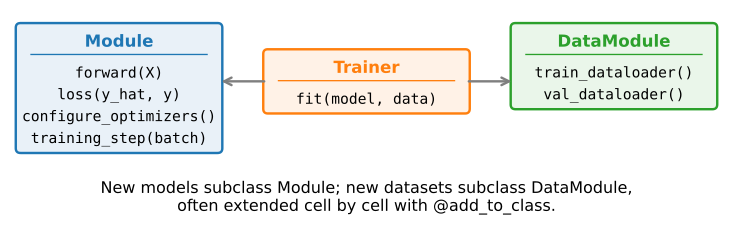
The dataset lives in a DataModule (the object-oriented-design section): where the batches come from, kept separate from the model.