Adversarial Image Generation
Dive into Deep Learning · §16.5
Adversarial image generation
the 2015 recipe · a modern minimal backbone · the loss A/B · measuring sample quality · limited data
The 2015 Recipe Stabilizes the Classic Objective
DCGAN (Radford et al., 2015) made the classic loss train on images through architectural commitments:
- transposed-conv upsampling in G, strided conv in D;
- batch normalization in both networks;
- ReLU + tanh output in G, leaky ReLU in D; Adam with \beta_1 = 0.5.
Together, these choices control activation and optimizer statistics as the two networks change. The objective remains the non-saturating log loss of :numref:sec_basic_gan.
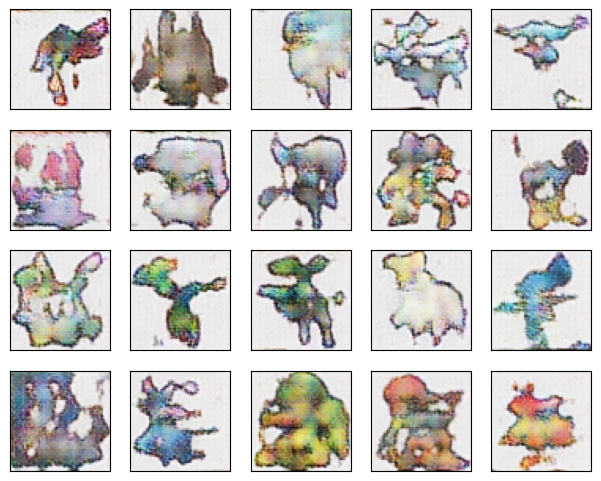
The Historical Baseline on Pokemon Sprites
The samples have plausible palettes and rough sprite-like silhouettes. The architecture made the classic loss practical on images, but normalization does not remove its mode-dropping minima or divergent dynamics.
A Modern Minimal Backbone
R3GAN’s principles at sprite scale:
- bilinear resampling + 3 \times 3 conv (no strided/transposed conv);
- leaky ReLU everywhere; no tanh; no normalization anywhere;
- Adam \beta_1 = 0, lr 2 \cdot 10^{-4}; flip augmentation; weight EMA.
Latent injection: project z linearly to 4 \times 4, concatenate with the learned constant, fuse with a mix conv — a deliberate simplification of R3GAN’s basis layer (z-modulated learned 4 \times 4 feature maps).
One Backbone, Two Losses
Identical backbone, initialization, optimizer, augmentation, EMA, and budget (15,000 steps). Only the loss differs:
- classic:
d2l.update_D / d2l.update_G — the non-saturating log loss of :numref:sec_basic_gan;
- RpGAN + R_1{+}R_2:
d2l.rpgan_loss_D/G + d2l.r1_r2_penalty, \gamma = 10 — the loss of :numref:sec_gan_convergence.
\gamma picked by sweeping powers of ten: 1–100 all stable here, 0.1 collapses. R3GAN tunes \gamma from 0.05 to 150 per dataset — no single value is portable.
The arms differ in the complete loss recipe: pairing and penalties change together. The toy experiment in :numref:sec_gan_convergence and the cited StackedMNIST ablation isolate the individual components.
The Penalized Relativistic Loss Avoids Collapse
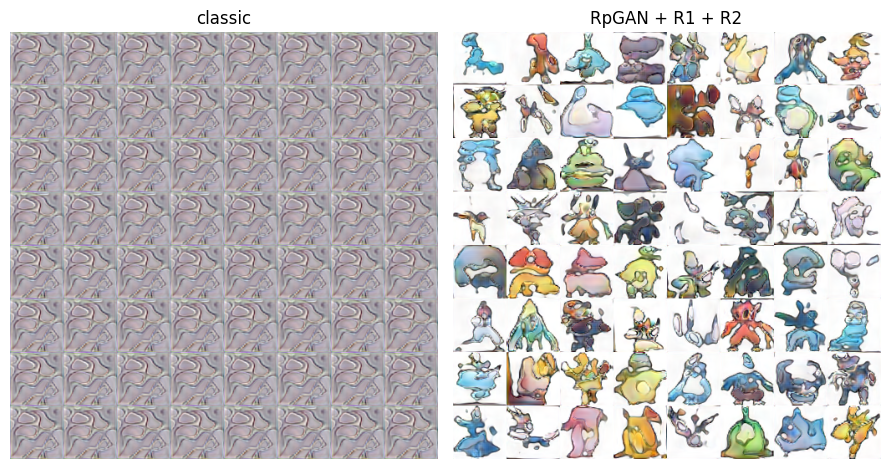
- Classic arm: complete collapse — all 64 latent codes map to the same image. Initialization-dependent: framework-default inits survive this budget; the 2015 recipe’s \mathcal{N}(0, 0.02^2) reaches the mode-dropping minima.
- Penalized relativistic arm: diverse, creature-shaped sprites, no repeats; critic train–holdout gap \approx 0 — this critic does not separate the sets. Generator memorization is a separate test: the nearest-neighbor check of :numref:
subsec_gan_limited_data.
Critic Scores Diverge under the Classic Recipe
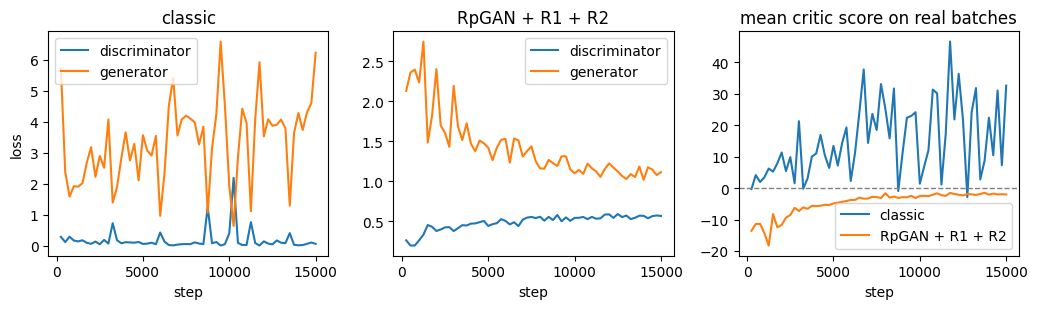
- Classic: D’s loss remains near 0, while its real-image scores grow without bound and oscillate widely.
- Penalized: both losses remain near equilibrium. The critic’s mean score stays within a narrow band whose location is arbitrary because the pairing objective is shift invariant. The A/B changes the objective and penalties together, so it does not isolate the source of the bounded behavior.
KID Is the MMD U-Statistic with Learned Features
run                     FD (CIFAR-CNN)  MMD^2 (CIFAR-CNN)  out-of-range
real vs. real                     0.53               0.03            --
classic                         104.05              26.99         0.000
RpGAN + R1 + R2                   2.50               0.67         0.157
Unbiased MMD^2 estimator, polynomial kernel on learned features — the kernel choice :numref:sec_gan_objectives fixed, reopened. Our cells print FD / MMD^2 (CIFAR-CNN): the same formulas on chapter-trained features, not comparable to published FID/KID. Real-vs-real floor \approx 0 — unbiased, so in principle it can even print negative; both scores rank the penalized run far above the collapsed one, with the floor two orders of magnitude below the gap.
What the Numbers Do Not Settle
- Feature dependence: scores depend on \phi. Using a CIFAR-trained CNN to score sprites has the same type of distribution mismatch as using an ImageNet-trained Inception network on other image domains.
- Leakage: FID drops by matching ImageNet class histograms (Kynkäänniemi et al., 2023); R3GAN avoids pretrained discriminators for this reason.
- Resizing: aliased image resizing shifts FID by method-sized margins (Parmar et al., 2022).
- Bias: model-dependent at finite n (Chong & Forsyth, 2020).
- Precision/recall separate fidelity from coverage: a collapsed generator can keep precision while recall \to 0.
On Limited Data the Critic Memorizes First
- Small real set + capable critic: scores drift from density ratio to set membership; the train–holdout score gap is the overfitting statistic.
- Fix: augment both real and generated inputs of D, differentiably (Zhao et al., 2020) — augmenting reals alone teaches G the augmented distribution. ADA feedback-controls the strength from an overfitting statistic (Karras et al., 2020).
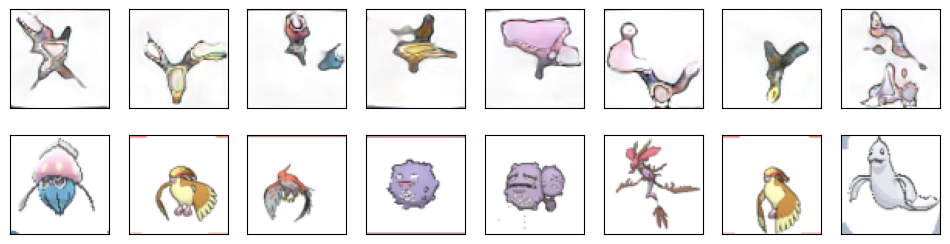
median distance to nearest training image: generated 1.99, held-out real 0.68
The generator-side check is calibrated with held-out real images. Generated samples lie farther from the training set than held-out sprites do, and even the closest pairs depict different creatures. This test finds no evidence of direct copying.
Scale Changes the Constants, Not the Recipe
R3GAN’s real budgets (quoted):
| StackedMNIST |
7 h on 8 L40 |
| CIFAR-10 |
4 days on 8 L40 |
| FFHQ-256 |
~3 weeks on 8 A6000 |
| ImageNet (cond.) |
~1 day on 32 H100 |
At scale: \gamma per dataset (0.05–150), BF16 not FP16, EMA half-life in Mimg, tuned augmentation. Steering the sampler with a class or caption: :numref:sec_gan_conditional.
Recap
- 2015: architecture stabilizes the classic objective. The modern recipe combines a regularized objective with a simpler backbone.
- Progressive growing, spectral normalization, attention, and style blocks address distinct architectural and optimization problems. R3GAN’s control shows which stabilizers become unnecessary after changing the objective.
- Same backbone, same budget: classic loss collapses completely from the 2015-recipe init (framework defaults survive the budget); RpGAN + R_1{+}R_2 at \gamma = 10 trains stably to diverse sprites.
- FID = Bures–Wasserstein W_2^2; KID = unbiased MMD — the chapter’s two closed forms, in learned feature space.
- Both metrics strongly prefer the penalized arm; the ordering is more transferable than the numerical values.
- Every metric inherits its meaning from its feature network.
- Next: steering the sampler with conditions (:numref:
sec_gan_conditional), then where the adversarial loss survives beyond stand-alone GANs (:numref:sec_gan_beyond).