from d2l import jax as d2l
from flax import linen as nn
from jax import numpy as jnp
import jaxDense block
Densely Connected Networks (DenseNet)
DenseNet concatenates features
DenseNet (Huang et al., 2017) takes the residual idea one step further: instead of adding skip connections, concatenate them.
\mathbf{x}_\ell = f_\ell\bigl([\mathbf{x}_0, \mathbf{x}_1, \dots, \mathbf{x}_{\ell-1}]\bigr).
Every layer in a dense block sees the concatenation of all preceding outputs.
Dense block + transition
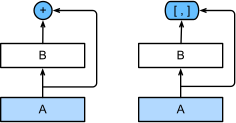
Dense block grows channels by concatenation; transition layers (1×1 conv + pool) reset channels between blocks.
Pros: maximum feature reuse, fewer parameters than ResNet for similar accuracy. Cons: memory grows linearly with depth within a block — handled by transitions.
Conv block
A small conv block (BN → ReLU → 3×3 conv) is the unit; a DenseBlock will reuse it repeatedly.
Now stack the conv blocks. After each block, concatenate its new features onto the running input, so later blocks see everything computed so far.
Channel growth
A DenseBlock(num_convs=2, num_channels=10) on a 3-channel input grows channels by num_convs * num_channels per block:
(4, 8, 8, 23)Transition layer
Stops the channel explosion between dense blocks: 1×1 conv halves channels, 2×2 avg-pool halves spatial dims:
The DenseNet model
A standard “stem → dense block → transition → dense block → transition → … → global avg-pool → linear” pipeline:
class DenseNet(d2l.Classifier):
    num_channels: int = 64
    growth_rate: int = 32
    arch: tuple = (4, 4, 4, 4)
    lr: float = 0.1
    num_classes: int = 10
    training: bool = True

    def setup(self):
        self.net = self.create_net()

    def b1(self):
        return nn.Sequential([
            nn.Conv(64, kernel_size=(7, 7), strides=(2, 2), padding='same'),
            nn.BatchNorm(not self.training),
            nn.relu,
            lambda x: nn.max_pool(x, window_shape=(3, 3),
                                  strides=(2, 2), padding='same')
        ])
def create_net(self):
net = self.b1()
for i, num_convs in enumerate(self.arch):
net.layers.extend([DenseBlock(num_convs, self.growth_rate,
training=self.training)])
# The number of output channels in the previous dense block
num_channels = self.num_channels + (num_convs * self.growth_rate)
# A transition layer that halves the number of channels is added
# between the dense blocks
if i != len(self.arch) - 1:
num_channels //= 2
net.layers.extend([TransitionBlock(num_channels,
training=self.training)])
net.layers.extend([
nn.BatchNorm(not self.training),
nn.relu,
lambda x: nn.avg_pool(x, window_shape=x.shape[1:3],
strides=x.shape[1:3], padding='valid'),
lambda x: x.reshape((x.shape[0], -1)),
nn.Dense(self.num_classes)
])
return netTraining
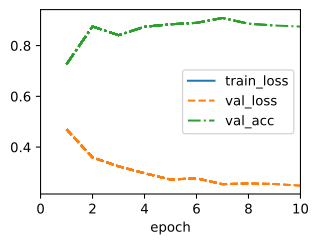
DenseNet hits competitive ImageNet accuracy with far fewer parameters than equivalent ResNets — the concatenation reuse genuinely helps.
Recap
- ResNet adds skip connections; DenseNet concatenates them.
- Inside a dense block, layer \ell sees all of layers 0, …, \ell-1 — maximum feature reuse.
- Transition layers between dense blocks rein in the channel-count explosion via 1×1 conv + pool.
- Same parameter count → typically better accuracy than ResNet; same accuracy → fewer parameters.