from d2l import jax as d2l
import jax
from jax import numpy as jnpTwo GPUs, two independent jobs
Automatic Parallelism
Once the framework runs asynchronously and tracks dependencies, two kinds of parallelism happen for free:
- Independent ops on different devices — if op A doesn’t depend on op B, the scheduler can run them in parallel on GPU 0 and GPU 1.
- Computation overlapped with communication — while the GPUs reduce gradients across the network, the next layer’s forward pass can start running.
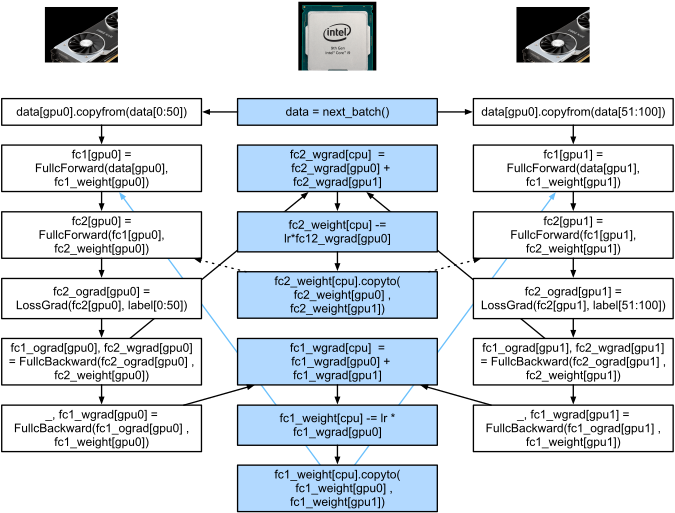
Two-layer MLP scheduled across CPU and 2 GPUs — independent branches run in parallel.
You don’t write any threads. The dependency tracker does it for you. This deck quantifies the speedup.
Run the same matmul on GPU 0 and GPU 1 separately, then run both at the same time:
devices = jax.devices('gpu')
def run(x):
    return [jnp.dot(x, x) for _ in range(50)]

x_gpu1 = jax.device_put(jax.random.normal(jax.random.PRNGKey(0), (4000, 4000)),
                         devices[0])
x_gpu2 = jax.device_put(jax.random.normal(jax.random.PRNGKey(1), (4000, 4000)),
devices[1])run(x_gpu1)[-1].block_until_ready() # Warm-up both devices
run(x_gpu2)[-1].block_until_ready()
with d2l.Benchmark('GPU1 time'):
run(x_gpu1)[-1].block_until_ready()
with d2l.Benchmark('GPU2 time'):
run(x_gpu2)[-1].block_until_ready()GPU1 time: 0.0792 sec
GPU2 time: 0.0829 secwith d2l.Benchmark('GPU1 & GPU2'):
run(x_gpu1)
run(x_gpu2)[-1].block_until_ready()GPU1 & GPU2: 0.1077 secConcurrent run is roughly the time of one GPU — the scheduler used both in parallel.