Softmax-normalized weights

Queries, Keys, and Values

Queries, Keys, and Values

The seq2seq encoder squashes the entire source into one fixed-size vector — no matter the sentence length. Works for short sentences, breaks for long ones.

Attention as soft database lookup

A database is a set of (\text{key}, \text{value}) pairs; a query retrieves the matching value. Attention is the differentiable, soft version:

\text{Attention}(\mathbf{q}, \mathcal{D}) = \sum_{i=1}^{m} \alpha(\mathbf{q}, \mathbf{k}_i) \mathbf{v}_i.

Sharp \alpha → database lookup; uniform \alpha → average pooling. Everything in between is attention.
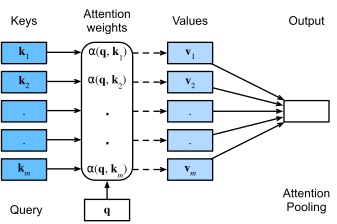
Attention pooling: linear combination of values, weights from query–key compatibility.

Setup

from d2l import jax as d2l
from jax import numpy as jnp

Most often we want \alpha to be a convex combination — non- negative and sum to one. Pick any scoring function a(\mathbf{q}, \mathbf{k}) and softmax it:

\alpha(\mathbf{q}, \mathbf{k}_i) = \frac{\exp(a(\mathbf{q}, \mathbf{k}_i))}{\sum_j \exp(a(\mathbf{q}, \mathbf{k}_j))}.

Differentiable, easy to batch, and available in every framework. But saturated logits give tiny gradients, so score scaling and masking details matter. The rest of the chapter is about choices for a and what to put in \mathbf{q}, \mathbf{k}, \mathbf{v}.

show_heatmaps

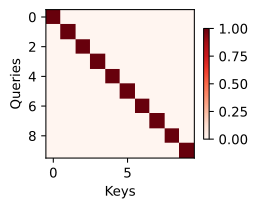
Visualizing attention weights as a (queries × keys) heatmap is the standard diagnostic. We’ll need it in every section ahead, so package it now:

def show_heatmaps(matrices, xlabel, ylabel, titles=None, figsize=(2.5, 2.5),
                  cmap='Reds'):
    """Show heatmaps of matrices."""
    d2l.use_svg_display()
    num_rows, num_cols, _, _ = matrices.shape
    fig, axes = d2l.plt.subplots(num_rows, num_cols, figsize=figsize,
                                 sharex=True, sharey=True, squeeze=False)
    for i, (row_axes, row_matrices) in enumerate(zip(axes, matrices)):
        for j, (ax, matrix) in enumerate(zip(row_axes, row_matrices)):
            pcm = ax.imshow(matrix, cmap=cmap)
            if i == num_rows - 1:
                ax.set_xlabel(xlabel)
            if j == 0:
                ax.set_ylabel(ylabel)
            if titles:
                ax.set_title(titles[j])
    fig.colorbar(pcm, ax=axes, shrink=0.6);

Sanity check

Identity attention — each query picks the matching key:

attention_weights = d2l.reshape(d2l.eye(10), (1, 1, 10, 10))
show_heatmaps(attention_weights, xlabel='Keys', ylabel='Queries')
Recap

  • Attention = soft, differentiable database lookup.
  • \text{Attention}(\mathbf{q}, \mathcal{D}) = \sum_i \alpha_i \mathbf{v}_i with weights derived from compatibility a(\mathbf{q}, \mathbf{k}_i).
  • Softmax of any scoring function \Rightarrow valid convex weights; that’s what every modern attention mechanism uses.
  • Operates on arbitrary-size databases — no fixed input width required.
  • Sharp/uniform/single-hot weights recover lookup, average pooling, and database query as limit cases.