import tensorflow as tf
from d2l import tensorflow as d2lLeNet-5 (Yann LeCun et al., 1989; deployed in the 1990s) recognized handwritten digits on bank checks.
Its organization—a convolutional encoder in which spatial dimensions shrink and channels grow, followed by a dense head—influenced many later CNN architectures.
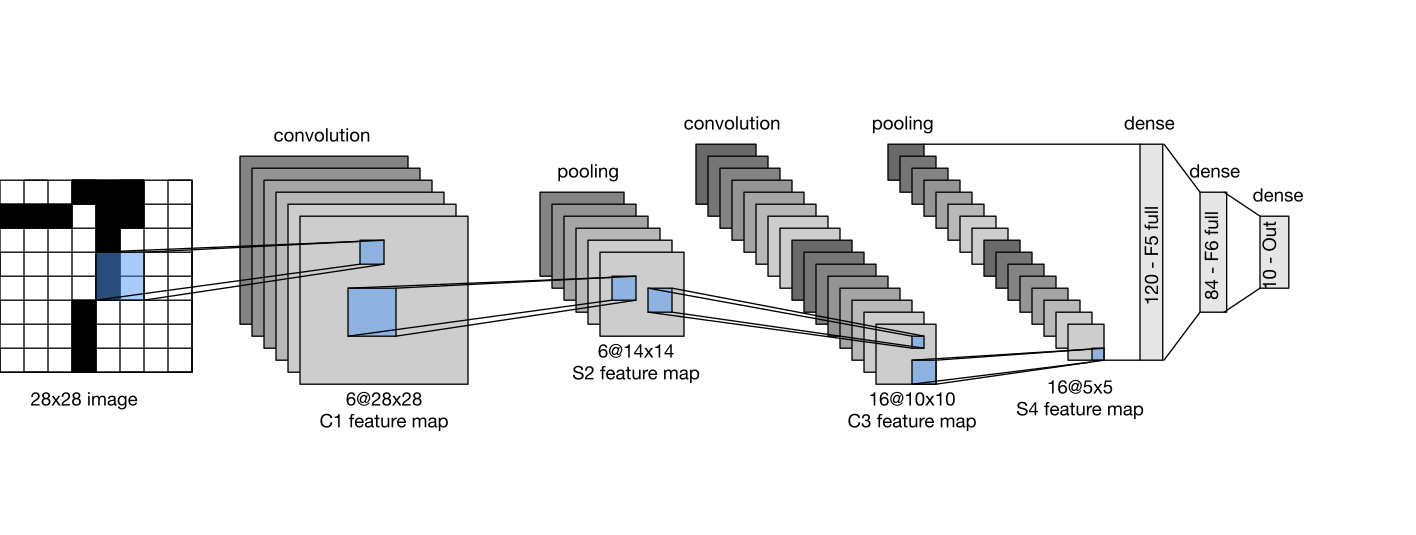
LeNet-5 data flow on a 28×28 handwritten digit. Spatial dims shrink; channels grow.
Two conv→sigmoid→avgpool blocks, three FC layers, 10 logits.
Same network, vertical schematic (the textbook version):
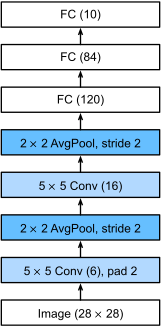
Compact LeNet-5 schematic.
400 × 120 = 48000 weights from conv block to first dense layer. Modern CNNs replace the dense stack with global average pooling, which is much cheaper.The figure translates directly to a Sequential model. Xavier initialization helps keep the sigmoid layers from saturating early in training:
class LeNet(d2l.Classifier):
"""The LeNet-5 model."""
def __init__(self, lr=0.1, num_classes=10):
super().__init__()
self.save_hyperparameters()
self.net = tf.keras.models.Sequential([
tf.keras.layers.Conv2D(filters=6, kernel_size=5,
activation='sigmoid', padding='same'),
tf.keras.layers.AvgPool2D(pool_size=2, strides=2),
tf.keras.layers.Conv2D(filters=16, kernel_size=5,
activation='sigmoid'),
tf.keras.layers.AvgPool2D(pool_size=2, strides=2),
tf.keras.layers.Flatten(),
tf.keras.layers.Dense(120, activation='sigmoid'),
tf.keras.layers.Dense(84, activation='sigmoid'),
tf.keras.layers.Dense(num_classes)])To check tensor shapes, pass a dummy (1, 1, 28, 28) input through the layers and print the shape after each. Match this against the figure to verify the architecture is wired correctly:
Conv2D output shape: (1, 28, 28, 6)
AveragePooling2D output shape: (1, 14, 14, 6)
Conv2D output shape: (1, 10, 10, 16)
AveragePooling2D output shape: (1, 5, 5, 16)
Flatten output shape: (1, 400)
Dense output shape: (1, 120)
Dense output shape: (1, 84)
Dense output shape: (1, 10)
The output confirms 28→28→14→10→5→flatten→120→84→10, matching the diagram.
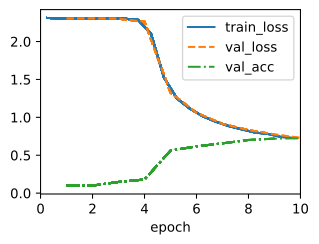
Cross-entropy loss + SGD + 10 epochs. Same Trainer API as every previous chapter; only the model changes:
Compare the result with the dense MLP from the previous chapter to assess the effect of LeNet’s convolutional inductive bias.
LeNet’s 1998 architecture vs. modern best practice:
| LeNet (1998) | Modern (2020s) |
|---|---|
| sigmoid activation | ReLU / GELU |
| average pooling | max pool / strided conv |
| no normalization | BatchNorm / LayerNorm |
| dense head | global average pool + 1 linear |
| Xavier init | He init |
| 5 layers, ~60k params | 50+ layers, millions of params |
Each substitution is a section of the next chapter, Modern CNNs (He initialization was introduced in the builder’s guide). The overall convolutional encoder + head organization is retained.