Adam

Dive into Deep Learning · §9.6

Per-coordinate learning rates and the modern default
AdaGrad → RMSProp → Adam · a tiny transformer testbed · where Adam wins

Motivation for per-coordinate learning rates

Motivation

Momentum fixed the direction; the step size per coordinate is still one global \eta.

  • Rare features (rare words, rare users) get meaningful gradients rarely; by the time they arrive, a decayed \eta is too small to use them.
  • The ill-conditioned valley: the ideal fix is a preconditioner, one step size per direction. Curvature is unaffordable; the gradient’s own history is not.

AdaGrad (Duchi, Hazan & Singer, 2011): decay each coordinate by its own activity,

\mathbf{s}_t = \mathbf{s}_{t-1} + \mathbf{g}_t^2,\qquad \mathbf{x}_{t+1} = \mathbf{x}_t - \frac{\eta}{\sqrt{\mathbf{s}_t + \epsilon}} \odot \mathbf{g}_t.

AdaGrad on the valley

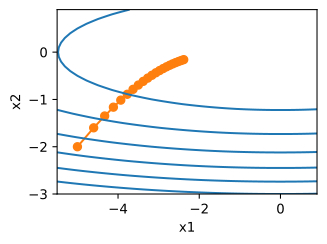
On the quadratic from the momentum section, \eta = 0.4 produces a smooth trajectory without oscillation, but the accumulated \mathbf{s}_t makes later steps progressively smaller:
def adagrad_2d(x1, x2, s1, s2):
    eps = 1e-6
    g1, g2 = 0.2 * x1, 4 * x2
    s1 += g1 ** 2
    s2 += g2 ** 2
    x1 -= eta / math.sqrt(s1 + eps) * g1
    x2 -= eta / math.sqrt(s2 + eps) * g2
    return x1, x2, s1, s2

def f_2d(x1, x2):
    return 0.1 * x1 ** 2 + 2 * x2 ** 2

eta = 0.4
d2l.show_trace_2d(f_2d, d2l.train_2d(adagrad_2d))

epoch 20, x1: -2.382563, x2: -0.158591

The scaling is adaptive, so a formerly unthinkable \eta = 2 is safe:

eta = 2
d2l.show_trace_2d(f_2d, d2l.train_2d(adagrad_2d))
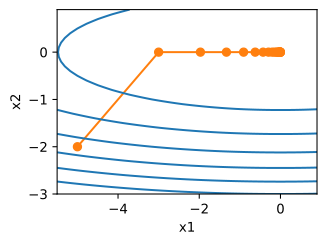
epoch 20, x1: -0.002295, x2: -0.000000

RMSProp: an exponential average

AdaGrad never forgets: \mathbf{s}_t grows forever, steps decay like t^{-1/2} by construction. This rate suits its original convex setting but can prevent substantial late movement in deep-network training.

RMSProp (Hinton, 2012): same rule, leaky average instead of sum,

\mathbf{v}_t = \beta_2 \mathbf{v}_{t-1} + (1-\beta_2)\, \mathbf{g}_t^2,

with memory \approx 1/(1-\beta_2) steps. The learning rate becomes an independent knob (→ schedules).

def rmsprop_2d(x1, x2, v1, v2):
    g1, g2, eps = 0.2 * x1, 4 * x2, 1e-6
    v1 = beta2 * v1 + (1 - beta2) * g1 ** 2
    v2 = beta2 * v2 + (1 - beta2) * g2 ** 2
    x1 -= eta / math.sqrt(v1 + eps) * g1
    x2 -= eta / math.sqrt(v2 + eps) * g2
    return x1, x2, v1, v2

eta, beta2 = 0.4, 0.9
d2l.show_trace_2d(f_2d, d2l.train_2d(rmsprop_2d))
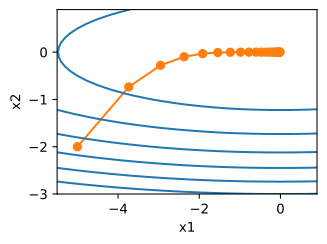
epoch 20, x1: -0.010599, x2: 0.000000

Adam = both moments, debiased

\mathbf{m}_t = \beta_1 \mathbf{m}_{t-1} + (1-\beta_1)\,\mathbf{g}_t, \qquad \mathbf{v}_t = \beta_2 \mathbf{v}_{t-1} + (1-\beta_2)\,\mathbf{g}_t^2,

\hat{\mathbf{m}}_t = \frac{\mathbf{m}_t}{1-\beta_1^t},\quad \hat{\mathbf{v}}_t = \frac{\mathbf{v}_t}{1-\beta_2^t},\qquad \mathbf{x}_{t+1} = \mathbf{x}_t - \eta\, \frac{\hat{\mathbf{m}}_t}{\sqrt{\hat{\mathbf{v}}_t} + \epsilon}.

  • Defaults \beta_1 = 0.9, \beta_2 = 0.999: direction averaged over ~10 steps, scale over ~1000.
  • Bias correction is exact: \mathbb{E}[\mathbf{v}_t] carries the fraction 1-\beta_2^t of the true scale; division cancels it at every t. After 10 steps, \mathbf{v}_t holds ~1% of its stationary value — without correction, Adam takes its largest early steps when the scale estimate uses the fewest samples.

From scratch

Two buffers per parameter plus a step counter:

def init_adam_states(feature_dim):
    m_w, m_b = d2l.zeros((feature_dim, 1)), d2l.zeros(1)
    v_w, v_b = d2l.zeros((feature_dim, 1)), d2l.zeros(1)
    return ((m_w, v_w), (m_b, v_b))

def adam(params, states, hyperparams):
    beta1, beta2, eps = 0.9, 0.999, 1e-6
    for p, (m, v) in zip(params, states):
        with torch.no_grad():
            m[:] = beta1 * m + (1 - beta1) * p.grad
            v[:] = beta2 * v + (1 - beta2) * torch.square(p.grad)
            m_hat = m / (1 - beta1 ** hyperparams['t'])
            v_hat = v / (1 - beta2 ** hyperparams['t'])
            p[:] -= hyperparams['lr'] * m_hat / (torch.sqrt(v_hat) + eps)
        p.grad.zero_()
    hyperparams['t'] += 1
d2l.train_ch11(adam, init_adam_states(feature_dim),
               {'lr': 0.01, 't': 1}, data_iter, feature_dim);
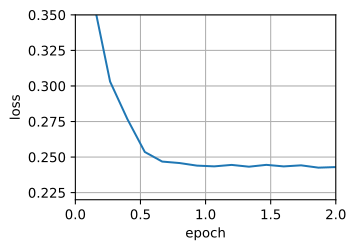
loss: 0.245, 0.076 sec/epoch

A tiny language model

The differences that matter show on language models. TinyLM: a decoder-only transformer (developed in Chapter 10), on the character-level Time Machine from ch. 8.

class TinyLM(nn.Module):
    """A small decoder-only transformer language model."""
    def __init__(self, vocab_size, d_model=128, num_heads=2, num_blks=2,
                 max_len=64):
        super().__init__()
        self.num_heads = num_heads
        self.token_emb = nn.Embedding(vocab_size, d_model)
        self.pos_emb = nn.Embedding(max_len, d_model)
        self.blks = nn.ModuleList([nn.ModuleDict(dict(
            norm1=nn.LayerNorm(d_model),
            qkv=nn.Linear(d_model, 3 * d_model),
            proj=nn.Linear(d_model, d_model),
            norm2=nn.LayerNorm(d_model),
            mlp=nn.Sequential(nn.Linear(d_model, 4 * d_model), nn.GELU(),
                              nn.Linear(4 * d_model, d_model))))
            for _ in range(num_blks)])
        self.norm = nn.LayerNorm(d_model)
        self.head = nn.Linear(d_model, vocab_size)

    def attention(self, blk, X):
        B, T, D = X.shape
        q, k, v = blk['qkv'](X).chunk(3, dim=-1)
        q, k, v = (u.reshape(B, T, self.num_heads, -1).transpose(1, 2)
                   for u in (q, k, v))
        Y = F.scaled_dot_product_attention(q, k, v, is_causal=True)
        return blk['proj'](Y.transpose(1, 2).reshape(B, T, D))

    def forward(self, X):
        H = self.token_emb(X) + self.pos_emb(torch.arange(X.shape[1],
                                                          device=X.device))
        for blk in self.blks:
            H = H + self.attention(blk, blk['norm1'](H))
            H = H + blk['mlp'](blk['norm2'](H))
        return self.head(self.norm(H))

Optimization depends on the model’s parameter groups and gradients rather than on the internal interpretation of the attention mechanism.

Parameter groups

Three populations — later sections treat them differently (decay exclusions, matrix vs. non-matrix preconditioning):

parameter              shape            count
token_emb.weight       (28, 128)         3584
pos_emb.weight         (64, 128)         8192
blks.0.norm1.weight    (128,)             128
blks.0.norm1.bias      (128,)             128
blks.0.qkv.weight      (384, 128)       49152
...
head.weight            (28, 128)         3584
head.bias              (28,)               28
                           embeddings   11776
                             matrices  396800
                              vectors    3612
                                total  412188
  • embeddings: rows update only when their token occurs
  • matrices: ~96% of all parameters
  • vectors: LayerNorm scales and biases

Tuned SGD and Adam on a language model

The comparison uses the same model, initialization, 2,000-step budget, and constant learning-rate protocol. Each method receives a four-point grid and is compared at its lowest final training loss.

On the language model:
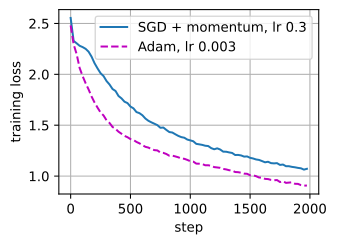
final perplexity: SGD 2.92, Adam 2.49
  • SGD’s best lr sits one grid point below divergence; Adam’s optimum is interior.
  • The gap opens early and no rate in our grid closes it.

Tuned SGD and Adam on a CNN
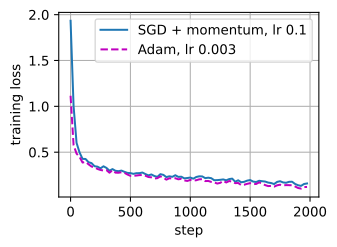
test accuracy: SGD 0.904, Adam 0.919
  • Curves nearly coincide; test accuracy within a point or two, either way.
  • The small difference is consistent with the long use of SGD in computer vision. Optimizer rankings depend on the model as well as the tuning.

Effect of parameter heterogeneity

Live research, but the threads agree (Kunstner et al. 2023, 2024; Zhang et al. 2024):

  • Not minibatch noise: the gap persists full-batch; Adam tracks sign descent (\sqrt{\hat{\mathbf{v}}} \approx |\hat{\mathbf{m}}| → step \approx \eta\,\mathrm{sign}(\hat{\mathbf{m}})).
  • Language is heavy-tailed: GD stalls on rare tokens; Adam keeps moving on all of them.
  • Transformer blocks have wildly different curvature; CNN blocks look alike. One global \eta must be stable for the stiffest block, which slows the remaining blocks.

Recap

  • Adam = per-coordinate scaling (AdaGrad) + forgetting (RMSProp) + momentum + exact bias correction.
  • Cost: two state buffers per parameter, for three times the parameter memory.
  • At matched tuning, Adam improves substantially on the transformer and only slightly on the CNN.
  • \epsilon is a step ceiling \eta/\epsilon, not just a numerical guard; AMSGrad/Yogi patch the variance estimate (exercises).