LAYOUTS = {'linear': 'GGGG', 'attention': 'AAAA', 'hybrid': 'GGAG'}Hybrid Architectures
Dive into Deep Learning · §12.7
Hybrid Architectures
fixed-state capacity · attention-cache growth · recall with one attention layer · deployed configurations
Finite-State Recall Limit
Five upgrades this chapter — gate, linearize, select, edit, learn — and none changed the state’s size.
- Reproducing k tokens from vocabulary V needs k \log_2 V bits, held from write to query.
- Copy bound (Jelassi et al. 2024): a finite-state model errs with probability \ge 1 - |\mathcal{S}|/D^L on uniformly random length-L strings — a counting argument, no training trick appears in it.
Measured: a 410M transformer beats a 2.8B Mamba on phone-book lookup past ~70 entries.
The diagnosis: associative recall
Where the wall bites in real text (Zoology, Arora et al. 2024):
- 82% of the perplexity gap between efficient models and attention sits on the recall slice — tokens requiring retrieval of a binding seen once.
- Attention solves MQAR at width independent of length; a fixed state only while bindings fit.
Production symptom: fuzzy recall — MMLU 29 vs 46 at matched 8B; ablate a hybrid’s few attention layers and needle-in-a-haystack drops to ~0.
Attention-Layer Cache Cost
Per layer, at production width (16-bit):
- Full attention (GQA 8 \times 128): 4 KB per token — 512 MB per layer at 128K context.
- Mamba-2 state: ~2 MB, constant in context length.
The hybrid cache equals the attention fraction times the transformer cache.
Jamba Cache at 256K Context
| model | KV cache |
|---|---|
| Llama-2-70B-class | 128 GB |
| Mixtral | 32 GB |
| Jamba (4 attn of 32 layers) | 4 GB |
Recurrence removes the growing term; the constant state can still be quantized, but nothing grows. The surviving attention cache takes GQA / MLA / quantization on top.
Three matched models, one letter apart
Same depth, width, heads, MLPs, embeddings — only the mixer string differs:
'G'=ScalarGatedMixer: scalar-per-head decay, Mamba-2’s rung of the decay ladder (not GLA’s per-coordinate gate), trained via the quadratic dual.'A'= the causal attention of ch. 11, throughd2l.TransformerBlock’sattn_factoryhook.- Printed parameter counts: 58,544 / 57,984 / 58,404 — spread < 1%.
Three lessons before training
A fresh gate must retain. Default init → a \approx 0.5: state half-life of one token, chance recall at every load. Bias -4.5 → a \approx 0.99. (S4D, Mamba, Gated DeltaNet all ship this trick.)
Mask before exp. The dual’s \exp(\textrm{cum}_i - \textrm{cum}_j) is large and positive above the diagonal; trained decays → 0 make it overflow: inf * 0 = nan. Mask with -\infty in log space first — only the LM panel triggers it, never the recall task.
Normalize the read-out. \mathbf{S}^\top \mathbf{q} grows with what the state has accumulated (\sqrt{T} at init); per-head RMSNorm before W_o; otherwise, recurrent-block outputs dominate the residual stream before it reaches the downstream attention layer.
Recall with One Attention Layer
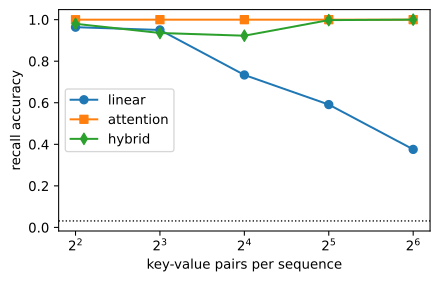
- Linear: degradation, then collapse at 64 pairs — the crowding heuristic’s cliff for 8 \times 8 head states (a diagnostic analogy, not a theorem about this trained stack).
- Hybrid = 3/4 the same recurrence + one mid-stack attention layer: 1.000 at every load (PyTorch); JAX dips to ~0.92–0.94 mid-sweep, then 0.99–1.00 at the loads that break the linear stack. Attention: 1.000 throughout.
Perplexity misses the deficit
Same three stacks as character LMs on The Time Machine:
     model  val loss  bits/char
    linear      1.78       2.57
 attention      1.83       2.65
hybrid 1.76 2.54- All within ~0.1 nat; the pure-linear model matches or beats pure attention — while collapsing on recall. (One pass, one small corpus, one seed: a demonstration.)
- At scale the dissociation is the rule: the perplexity gap sits on the rare recall tokens (Zoology); ratio sweeps move recall, barely perplexity (2507.06457). MQAR and needle probes exist because the training objective did not see the deficit.
Persistent decode state, measured
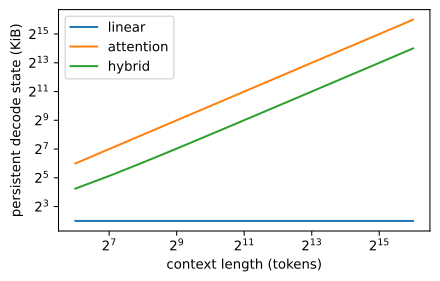
- KV cache + recurrent state only — parameters and activations are the same across stacks.
- Attention: grows linearly. Linear: 4 KiB at every length.
- Hybrid: slope = attention fraction (here 1/4).
The hybrid matches attention recall while retaining one quarter of the attention stack’s context-dependent state.
Design rules, measured
- Ratio: shipped 5–25% attention; ablation optimum ~8% (NVIDIA); DeltaNet-family knee at 3:1 (Kimi ablation). Recall climbs to ~1:3; perplexity flat throughout.
- Placement: evenly spread, not first in any report so far — one front attention layer broke Samba’s length extrapolation. A heuristic from a young design space, not a law.
- Parallel (Hymba, Falcon-H1): fuse per layer; beats sequential in controlled ablation.
- Sharing (Zamba2): re-enter two weight-tied attention blocks along the backbone.
Interactions Between Components
AI21 tested Mamba-2 in Jamba — the better standalone model — and rejected it.
- With attention layers pooling the full context, the recurrence no longer needs the bigger state.
- No quality difference 1:3 vs 1:7 at their scale → shipped the cheaper.
Evaluate the recurrent component together with the attention component. Once quality saturates, choose the less expensive configuration.
The recipe table
| model | layers | attention | recurrence | context |
|---|---|---|---|---|
| Jamba | 32 | 4 full, GQA | Mamba-1 | 256K |
| Nemotron-H | 52 | 4 full, GQA | Mamba-2 | 8K |
| Granite 4.0-H | 40 | 4 full, NoPE | Mamba-2 | 128K |
| Qwen3-Next | 48 | 12, GQA 16{:}2 | gated DeltaNet | 262K |
| Kimi Linear | 27 | 7 MLA, NoPE | KDA | 1M |
Every row: evenly spread, none first; the surviving attention wears every compression of ch. 11.
Distillation: duality warm-starts, data does the rest
Duality is exact for linear attention only; softmax attention is not a recurrence in disguise. Conversion is a learned approximation:
- MOHAWK: match mixing matrices → hidden states → fine-tune; Phi-1.5 → Mamba with ~3B tokens (<1% of scratch).
- Mamba-in-the-Llama: init recurrence from attention projections, keep ~1/4 of attention layers — recall survives at 20× training length; remove them all and it does not.
Architecture Comparison
Per layer: decode work / persistent state / training depth / exact?
| architecture | decode | state | depth | exact? |
|---|---|---|---|---|
| LSTM/GRU | O(d^2) | O(d) | T | no parallel form |
| S4D, Mamba-1 | O(dN) | dN | O(\log T) | yes |
| SSD / GLA / DeltaNet | O(h d_k d_v) | h d_k d_v | T/C | yes |
| softmax attention | O(td) ↑ | 2td ↑ | O(1) | by definition |
| 1-in-4 hybrid | mix | const + cache/4 | mix | per component |
The fixed state lost exact recall (a counting bound, plus our measured collapse) and won the economics (by a factor that grows with context). Production stopped choosing. Kernels → Computational Performance; pretrained stacks → the Language Models part.