Dive into Deep Learning · §15.3
Regularized policy optimization
preference-based rewards · proxy-reward optimization · fixed-reference penalties · a closed-form optimum
No formula scores a helpful answer; people can compare.
P(\tau \succ \tau') = \sigma\big( r(\tau) - r(\tau') \big)
Bradley-Terry: fitting r is logistic regression on feature differences.
Fit on 1000 trajectories from a competent reference: rms error 0.19 where the data lives, and the hazard lane, truly -1.5 to enter, is priced at \approx 0: the reference rarely entered it, so the data contain little evidence there. Its near-zero estimate follows from initialization and regularization.
Plan optimally against the fitted reward; grade under the truth.
plan on true reward : fitted return -0.24, true return +0.59
plan on fitted reward: fitted return -0.03, true return -2.11
The fitted-reward optimum enters the hazard lane. It scores higher under the fitted reward and substantially lower under the true reward, exposing unsupported reward estimates.
Per \beta: solve the regularized Bellman equations (soft, reference-weighted backup), residual printed; every point is an exact optimum.
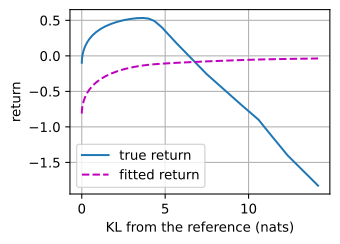
largest soft Bellman residual across the sweep: 0.0e+00
true return -0.10 at KL 0, peak +0.53 at KL 3.7, then -1.83 at KL 14.2
Gao.Schulman.Hilton.2023\max_{\pi}\ E_{a \sim \pi}\big[ r(a) \big] - \beta\, D_{\textrm{KL}}\big( \pi \Vert \pi_{\textrm{ref}} \big)
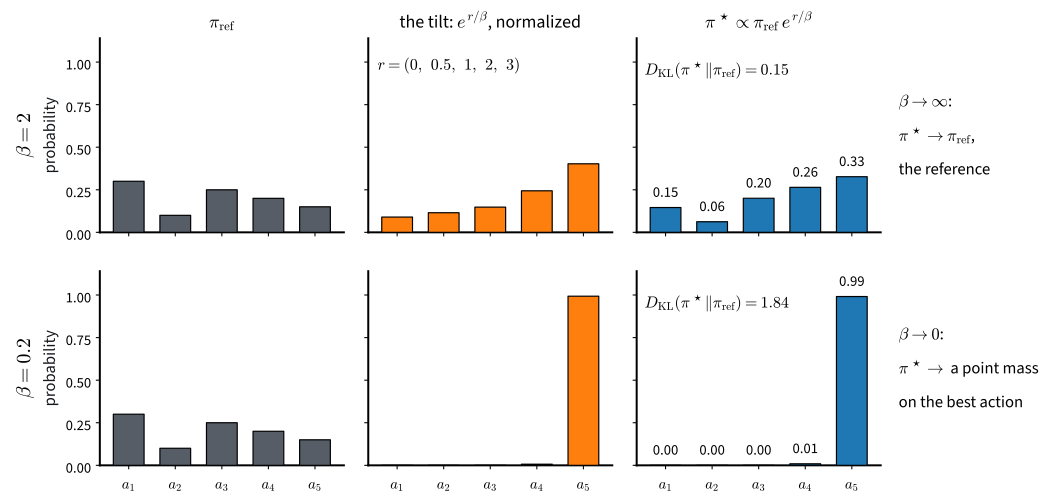
Proposition. \ \pi^\star(a) = \pi_{\textrm{ref}}(a)\, e^{r(a)/\beta} / Z, with value \beta \log Z.
Proof. The objective equals \beta \log Z - \beta\, D_{\textrm{KL}}(\pi \Vert \pi^\star); apply Gibbs’ inequality. \blacksquare
Verified numerically: largest gap over a ladder of \beta is \approx 10^{-16}.
The optimum is a product rather than a reward ranking: the reference’s dip at a_2 remains in \pi^\star. The divergences are 0.15 at \beta = 2 and 1.84 at \beta = 0.2.
Levine.2018,Korbak.Perez.Buckley.2022Trust region (the clip): against the previous iterate; constrains the path; gone at convergence.
Penalty (here): against a frozen reference; in the objective; changes the optimum.
PPO-RLHF runs both at once :cite:ouyang2022training.
Direction matters: D_{\textrm{KL}}(\pi \Vert \pi_{\textrm{ref}}) is mode-seeking, so post-training sharpens (:numref:sec_mdl-fwd-vs-rev-kl).
V(s) = \beta \log \sum_a \pi_{\textrm{ref}}(a \mid s)\, e^{Q(s, a)/\beta} \ \xrightarrow{\ \beta \to 0\ } \ \max_a Q(s, a)