from d2l import jax as d2l
from flax import nnx
from jax import numpy as jnpConvolutional Neural Networks (LeNet)
LeNet sets the CNN template
LeNet-5 (Yann LeCun et al., 1989; deployed in the 1990s) recognized handwritten digits on bank checks.
Its organization—a convolutional encoder in which spatial dimensions shrink and channels grow, followed by a dense head—influenced many later CNN architectures.
LeNet-5 architecture
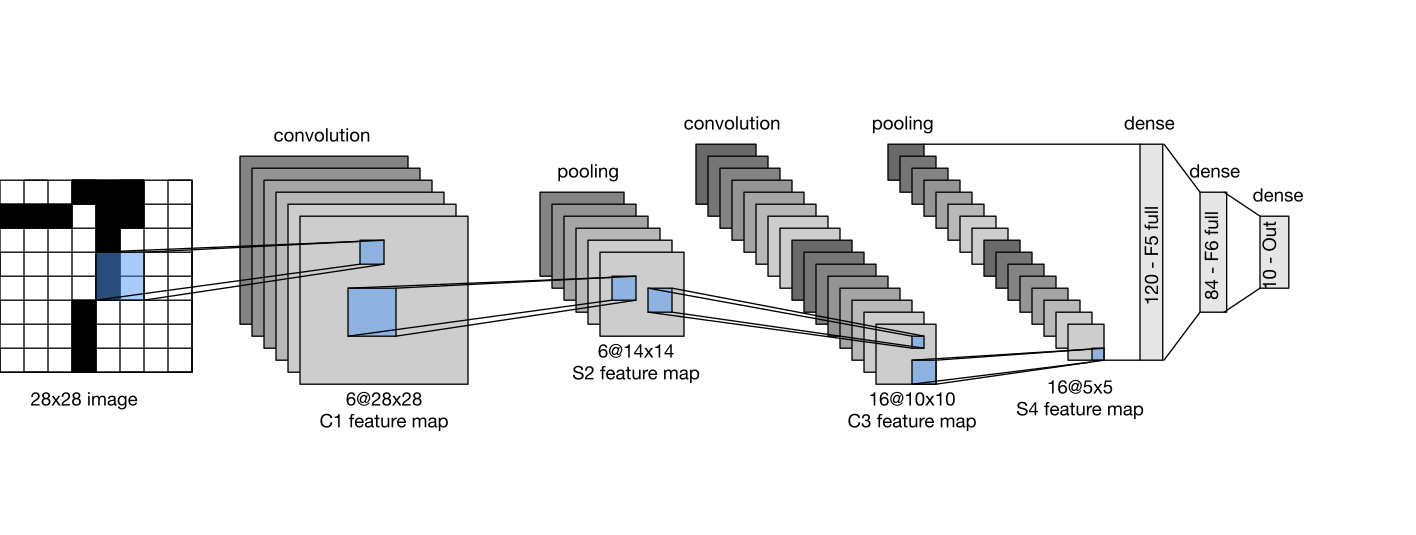
LeNet-5 data flow on a 28×28 handwritten digit. Spatial dims shrink; channels grow.
Layer-by-layer
- Conv1: 1→6 channels, 5×5 kernel, padding 2 (28→28)
- AvgPool: stride 2 → 14×14
- Conv2: 6→16 channels, 5×5, no padding → 10×10
- AvgPool: stride 2 → 5×5
- Flatten → 16·5·5 = 400 → 120 → 84 → 10
Two conv→sigmoid→avgpool blocks, three FC layers, 10 logits.
Compressed view
Same network, vertical schematic (the textbook version):
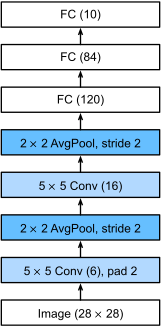
Compact LeNet-5 schematic.
Two takeaways
- Pyramid shape: spatial dimensions halve at each pooling layer while the number of channels increases. Many later CNNs retain this pattern.
- The bottleneck is the flatten:
400 × 120 = 48000weights from conv block to first dense layer. Modern CNNs replace the dense stack with global average pooling, which is much cheaper.
Implementation setup
The figure translates directly to a Sequential model. Xavier initialization helps keep the sigmoid layers from saturating early in training:
LeNet in code
LeNet initialization
class LeNet(d2l.Classifier):
    """The LeNet-5 model."""
    def __init__(self, lr=0.1, num_classes=10, kernel_init=None, rngs=None):
        super().__init__()
        self.save_hyperparameters(ignore=['rngs', 'kernel_init'])
        rngs = nnx.Rngs(d2l.get_key()) if rngs is None else rngs
        kernel_init = (nnx.initializers.xavier_uniform() if kernel_init is None
                       else kernel_init)
        self.net = nnx.Sequential(
            nnx.Conv(1, 6, kernel_size=(5, 5), padding='SAME',
                     kernel_init=kernel_init, rngs=rngs),
            nnx.sigmoid,
            lambda x: nnx.avg_pool(x, window_shape=(2, 2), strides=(2, 2)),
            nnx.Conv(6, 16, kernel_size=(5, 5), padding='VALID',
                     kernel_init=kernel_init, rngs=rngs),
            nnx.sigmoid,
            lambda x: nnx.avg_pool(x, window_shape=(2, 2), strides=(2, 2)),
            lambda x: x.reshape((x.shape[0], -1)),  # flatten
            nnx.Linear(400, 120, kernel_init=kernel_init, rngs=rngs),
            nnx.sigmoid,
            nnx.Linear(120, 84, kernel_init=kernel_init, rngs=rngs),
            nnx.sigmoid,
            nnx.Linear(84, num_classes, kernel_init=kernel_init, rngs=rngs))
Tracing shapes through the network
To check tensor shapes, pass a dummy (1, 1, 28, 28) input through the layers and print the shape after each. Match this against the figure to verify the architecture is wired correctly:
Conv output shape:   (1, 28, 28, 6)
PjitFunction output shape:   (1, 28, 28, 6)
function output shape:   (1, 14, 14, 6)
Conv output shape:   (1, 10, 10, 16)
PjitFunction output shape:   (1, 10, 10, 16)
function output shape:   (1, 5, 5, 16)
function output shape:   (1, 400)
Linear output shape:     (1, 120)
PjitFunction output shape:   (1, 120)
Linear output shape:     (1, 84)
PjitFunction output shape:   (1, 84)
Linear output shape:     (1, 10)
The output confirms 28→28→14→10→5→flatten→120→84→10, matching the diagram.
Training on Fashion-MNIST
Cross-entropy loss + SGD + 10 epochs. Same Trainer API as every previous chapter; only the model changes:
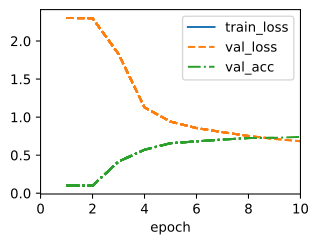
Compare the result with the dense MLP from the previous chapter to assess the effect of LeNet’s convolutional inductive bias.
What 30 years of progress changed
LeNet’s 1998 architecture vs. modern best practice:
| LeNet (1998) | Modern (2020s) |
|---|---|
| sigmoid activation | ReLU / GELU |
| average pooling | max pool / strided conv |
| no normalization | BatchNorm / LayerNorm |
| dense head | global average pool + 1 linear |
| Xavier init | He init |
| 5 layers, ~60k params | 50+ layers, millions of params |
Each substitution is a section of the next chapter, Modern CNNs (He initialization was introduced in the builder’s guide). The overall convolutional encoder + head organization is retained.
Recap
- LeNet-5 demonstrated a CNN in a deployed recognition system.
- Architectural template: conv encoder (spatial ↓, channels ↑) → flatten → dense head.
- Later CNNs such as ResNet and EfficientNet retain the encoder–head organization while changing its components and scale.
- The next chapter swaps every component for its modern equivalent and goes much deeper.